What Apple Actually Changed This Fall for ASO and Apple Ads

Apple made at least five changes to the App Store this fall, inside about three weeks, and most of them point the same direction: the line between your organic listing and your Apple Ads campaigns is getting thinner.
New Creative Assets, and Where They Live Now
iOS 27 and iPadOS 27 arrived Oct. 5 with a new asset format covering image or video slots for the product page header, the search results tile, and in-app event cards. Videos run 5 to 30 seconds, loop, and stay muted; images can’t carry transparency. None of it has to show the app in use.
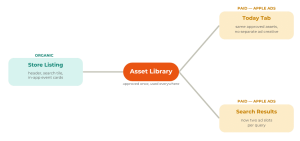
These same approved assets can power Apple Ads campaigns on the Today tab and in search results, as well as the store listing itself. Organic and paid creative now draw from one pool instead of two.
App Store Connect’s new Asset Library brings screenshots, previews, in-app event media, and the new assets together in one place. Assets can go through review on their own, without a new app version, and swap live once approved, which means seasonal creative no longer has to wait on a build. A new preview tool renders the whole listing, header included, across light and dark mode and multiple languages before anything goes public.
What the Review Guidelines Now Require
Apple revised the App Review Guidelines on Oct. 16, and two changes land directly on the new assets. Guideline 2.3.14 requires every creative asset to relate to the app’s actual content or function, meet a 4+ rating regardless of the app’s real rating, and skip anything resembling a price, a discount, a URL, or another platform’s badge. A promotional banner built for a sale can’t double as the evergreen header; that needs its own always-on version.
Separately, Guideline 3.1.1(a) folded the old Music Streaming Services entitlement into the broader External Purchase Link entitlement. Outside purchase links can now point to “a permitted destination,” and which destinations count varies by region, so a funnel built for one country’s rules may not carry over cleanly to the next.
A Second Ad Slot in Search Results
Apple Ads has been running two ads per search query instead of one, since a rollout that started in the UK in March and went global by the end of that month. The format and bidding haven’t changed. Apple made existing campaigns eligible automatically, so advertisers didn’t have to set up anything new to start winning the second slot.
Campaigns may start hitting daily budget caps earlier than before, since winning more auctions spends the budget faster. Cost per tap and cost per acquisition on priority keywords are worth checking next, along with whether competitors are starting to show up on searches for your own brand name. Since the same creative assets now feed both channels, this is also the moment to get the ASO and paid teams working off one keyword list instead of two.
A New Device Shape to Design For
The iPhone Duo opened for submissions Oct. 5 and went on sale Oct. 23. How an app’s layout holds up on it depends on which SDK built it:
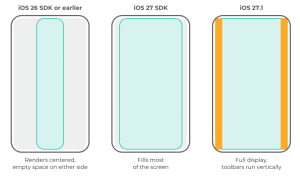
Screenshots for the new device become a required part of every App Store Connect submission starting April 2027. That’s a distant deadline, but screenshots convert, and testing the layout now costs less than scrambling for it next spring.
New EU Business Terms
Apple’s EU business terms changed Oct. 1. Three purchase paths now carry three different rates:
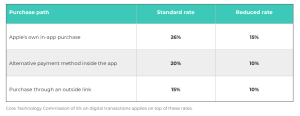
Apple’s commission on the outside-link rate still applies if the sale happens within seven days of the customer following that link. The old per-install Core Technology Fee for apps distributed outside the App Store is gone, replaced by a 5% Core Technology Commission on digital transactions.
A lower headline rate on the alternative routes doesn’t automatically mean lower total cost. Choosing one of them means taking on billing, tax, refunds, and monthly compliance reporting directly, with Apple keeping audit rights over those records, and once a developer picks a setup, it holds across every EU storefront for twelve months. None of this touches ASO directly, but it changes how much margin is left over to fund Apple Ads spend.
One More Signal
Search rankings themselves also moved more than usual this fall. One ASO tracking firm’s data showed US keyword positions shifting an average of about 12 places on Oct. 8, against a normal day’s roughly 1.7, with Google Play staying in its usual range over the same days. Apple hasn’t confirmed what caused it, or much else on this list. Almost none of it comes with a press release.
The Bigger Pattern
A listing and an ad campaign now draw on the same creative, answer to the same review rules, and increasingly compete for the same budget. None of the six changes above landed in isolation, and taken together, they argue for treating ASO and Apple Ads as one workflow this quarter rather than two separate ones run by two separate teams.
App Growth Summit stays ahead of shifts like these and turns them into the App Growth Playbooks the industry runs on, the same thinking behind every session on an App Growth Summit stage. To keep up with what’s changing next in the industry, check the AGS App Growth Articles library, and see the App Growth Summit events calendar for where these teams compare notes next in person.