AGS Barcelona 2026: Every Session From One Main Stage
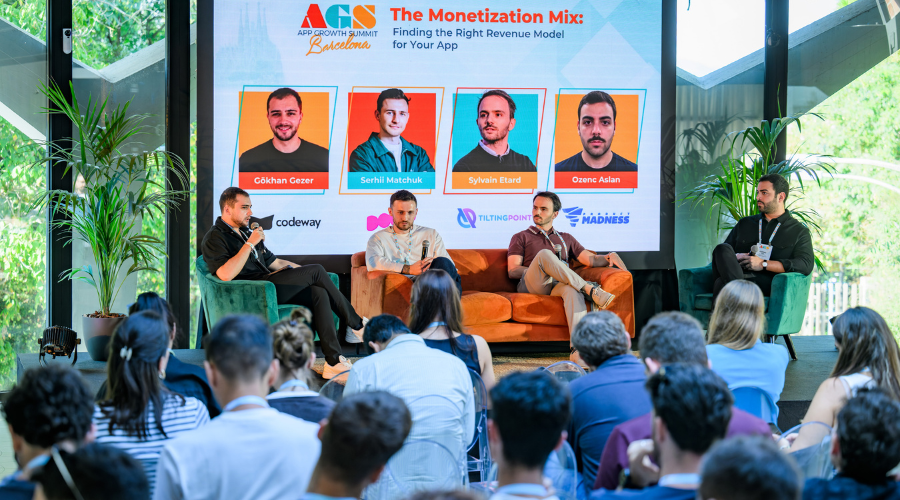
App Growth Summit Barcelona held its fourth edition this October at Eventos Esferic in Montjuïc Park.
The room held 300+ app growth professionals and 25+ speakers, all on a single Main Stage with no second room to choose between.
The full recap deck, every one of these sessions broken into its own slide, lands soon for anyone who wants the complete set in one place.
TheFork Turns a Four-Year Product-and-Marketing Experiment Into a Growth Wheel
Tharamaroa Troconis, Senior Product Manager at TheFork, opened the day with “Implementing Growth Funnels,” a look back at four years of alternating focus between SEO, onboarding, acquisition, and post-booking retention.

The headline number came from winning back diners who’d already booked through Google or another platform: convincing them to come back through TheFork instead moved weekly conversions from a few hundred to roughly 1,000, a 30%+ increase in partner-channel acquisition since the program started.
Every idea the team ships now has to answer four questions first: what’s the problem, for which segment, which funnel metric moves, and what it costs. This year’s results are already cleaner than last year’s, one flat test and one failed test against a string of wins, down from eight flat tests out of twenty bets in 2025.
Superwall Puts Eight Real Paywall Tests to a Live Audience Vote
Michal Parizek, Product & Customer Growth at Superwall, followed with “Guess the Winner: Real Paywall A/B Tests,” handing the room a QR code to call eight live paywall tests before each real winner appeared on screen.

Superwall runs an AI-powered monetization stack across 10,000+ apps and more than $1.6 billion in annual revenue, and every test came from that dataset. The day’s biggest lift came from a location-tracking app: swapping a neutral trial timeline for “Safety for Your Loved Ones” photography and a simpler monthly-or-yearly choice drove new revenue per user up 89% and new-to-trial conversion up 60%. One winner went against the room’s own guesses: a photo app that left its AI credit packs off the paywall entirely out-converted the version that listed them, by 14%.
Parizek closed with a benchmark from Superwall’s wider dataset: multi-page onboarding paywalls convert 37% better than single-page ones across more than 40 million paywall opens. His takeaway for the room: paywall experiments are one of the largest growth levers still on the table, and testing velocity matters as much as any single result.
Asapty Shows Why Installs-Per-Mille Decides Who Wins Apple Ads
Viktor Orlov, CEO and Co-Founder of Asapty, used “Apple Ads That Actually Scale” to walk through installs-per-mille, or IPM, as the metric the entire Apple Ads auction runs on.

His benchmark: generic keywords should land an IPM around 200 to 250, and anything meaningfully under that hits what he called an invisible wall, where Apple stops handing out impressions no matter how high the bid climbs.
One AI note-taking app that rebuilt ten custom product pages around its real keyword clusters scaled installs 13x while its price per install fell, the reward Apple hands out once relevance improves. A cautionary case went the other way: a betting client cut its other UA channels, which tanked branded search as a side effect, then raised Apple Ads bids to compensate and ended up paying 600% more per install within two weeks.
A Brand vs. Performance Panel Lands on One Shared Definition of a Winning Ad
Moderated by Sonia Donaire Garcia, Marketing Director at Tangelo Games, the panel put Cemre Korkmaz (Head of Growth, Codeway), Stanislav Berkutov (Head of User Acquisition, Reface), and Guy Boliston (Sales and Partnerships Lead, SpinX) on stage to argue out what makes an ad a winner.

Berkutov’s answer was the most direct: a winner ad clears Reface’s internal day-zero purchase threshold, though upper-funnel metrics like CTR still feed the next round of creative hypotheses. Korkmaz warned that chasing one winning element too long traps a team in a single audience niche.
All three landed on the same point about authenticity and algorithm-friendliness: the best creative starts from a real read on the user and lets the platform find the audience from there.
CRM Leads From Joko, Tandem, and Roamless Compare Notes on Reading Real User Behavior
Nick Peng, Head of CRM at Wise, moderated a panel with Agnès Malherbe (CRM & User Lifecycle Manager, Joko), Rodolphe Helderwerdt (VP of Marketing, Tandem), and Elsa Massoudi Aguilar (CRM Lead, Roamless).

Malherbe’s example: a user who opens Joko’s cashback wallet every day looks highly engaged until you cross-check it against their transaction history and find an unvalidated cashback payout sitting in the queue, meaning the right message is reassurance, not a loyalty nudge.
Massoudi Aguilar’s reactivation campaign to Roamless’s most inactive eSIM users pulled 40%+ open rates. Helderwerdt described building personalized World Cup fan-zone experiences inside Tandem’s app using an AI-assisted webview layer, shipped in a couple of days with no engineering request.
All three cited the same lesson from a costly mistake: capping engagement too aggressively on your most active users, Tandem briefly limited free daily conversations, can drain the acquisition pipeline a year later, since those same users are often the ones recruiting new signups informally.
Rovio and Bidease Walk Through Where AI Still Needs a Human in UA Analytics
Martin Boccardi, Senior UA Manager at Rovio, and Artur Lukasevic, Sales Director Europe at Bidease, traded real examples of AI catching problems early and still needing real human time to fix them.
Rovio’s anomaly-detection models flagged a click-to-install conversion drop within two days and isolated it down to a specific OS version and device set, but finding the actual code-level cause took two to three weeks, and shipping the fix took a month and a half, a gap that cost 10 to 15% of revenue over that stretch. Boccardi’s standing rule for predictive models: never act on one or two weeks of data alone, since seasonality and ordinary model drift both look identical to a real signal in the short term.
On DSP partnerships, his ask to every new network is the same: explain what the model is good at and where its blind spots sit, in place of a blanket promise that it just works.
Paddle Makes the Case for Taking Checkout Off the App Store
Megan Wong, Product Manager at Paddle, used “App2Web: Your New Competitive Advantage” to lay out why moving checkout to the web is picking up speed now that the EU’s new October 1 rules cut Apple’s standard in-app fee from 30% to 26% and set a flat 15% rate on web purchases, while the U.S. version of the same shift has been live and proven for over a year.

Her numbers: a typical app-to-web move costs 5 to 12% in conversion but nets a 10% average lift in lifetime value and a 24% average lift in proceeds, since the business keeps control of pricing, payment methods, and retry logic Apple never allowed. Apple Pay specifically lifted web conversion 5.4% over card-only checkout.
The App Store’s Small Business Program, 15% under $1M in proceeds and 30% above it, is the other lever Paddle sees apps use: push everything past that $1M line out to the web and the discount holds on everything under it.
Four Different Monetization Models All Come Back to Lifetime Value
Ozenc Aslan, Team Lead for Growth (AdTech) at Product Madness, moderated Gökhan Gezer (Head of Product, Language Learning, Codeway), Serhii Matchuk (Product Lead, DOWN), and Sylvain Etard (Associate Director of Growth, Tilting Point) through how differently four companies price the same basic freemium decision.
Codeway’s six years of testing keeps landing back on subscription as the strongest long-run model across its portfolio, even while it tests usage-based pricing for newer products.
DOWN runs an asymmetric model by design, free for its female users to protect retention, paid tiers and one-time purchases for male users, and found unbundling a popular subscription feature into a standalone one-time purchase outperformed the bundle it came from.
Tilting Point’s rule for any new monetization test: if it lifts revenue but measurably hurts the product experience, it doesn’t ship, no matter the upside.
Product Madness closed the panel on the point that mattered across all four: the biggest recent revenue win came from a core product change, a 20% conversion lift that came purely from reordering which users got shown first at signup.
BoomBit Argues the Ugliest Ad in the Account Is Sometimes the Best One
Angela Zafirovska, UA Release Team Lead at BoomBit, built “Your Best Performing Ad Probably Looks Wrong” around a simple, tested fact from across more than 4 million creatives: the deliberately rough, chaotic, lower-quality ad often beats the polished one.

Her clearest example is the game Mom Life, where a visibly low-polish creative has outspent and outperformed every high-quality variant made for the same game over the past two years. Her read: a scroll-stopping ad gets about 0.2 seconds to earn attention, and a familiar, polished ad reads as easier to skip, because users have learned to tune it out.
Use three-part framework for finding the next one: break the norm with cheap, chaotic test concepts, iterate fast on anything that already works before chasing a brand-new idea, and scale strictly by performance data once a winner shows up.
Getir’s Growth Manager Walks Through the Shift From Volume to Lifetime Value
Boaz Cohen, CRO at Edge226, hosted Aydan Tekin, Growth Manager at Getir, for a fireside chat on how the Turkish grocery-delivery company’s acquisition goals changed once the pandemic-era growth spike cooled off.
Tekin’s team now runs predictive models that call a user’s long-term value with roughly 80% accuracy right after their first order, a sharp pivot from the old approach of targeting by food-delivery behavior, which Getir can no longer access and has replaced with income and shopping-pattern signals instead.
One real test: pausing all paid acquisition targeting toward Getir’s most loyal customers for a stretch produced no drop in their order volume, confirming that budget was better spent reallocated to churn recovery and newer segments. A smaller, stranger signal her team tracks: phone size. Bigger screens correlate with bigger grocery baskets.
Rhythmic Runs Through 40 Ways to Market an App Without Spending on Ads
Gabe Kwakyi and Daniela Zarzer, co-founders of Rhythmic, moved fast through a list built from their own bootstrapped app studio. ASO comes first, the baseline everyone should already be doing. After that: a documented “organic octopus” process for building and warming up six social accounts before posting anything promotional, friends-and-family first reviews, and podcast guesting in both directions.
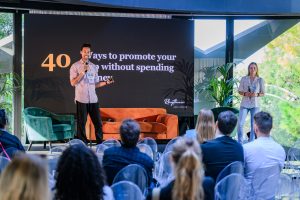
They’ve automated micro-influencer outreach through an AI agent that found and emailed 60 relevant accounts in one sitting, and they still show up in person at local community meetups before trying to scale anything online.
Their one caution on using AI for all of it: platforms are starting to flag and penalize obviously AI-generated social content, so a human still reviews anything that goes out under the brand’s own name. Their closing rule for anyone trying all 40 at once: pick a few, commit to 30 days before judging results, and expect the hustle-heavy ones, Reddit especially, to take real time to pay off.
Greentube Finds That Its Best-Looking Ad Channel Was Cannibalizing Its Own Organic Growth
Gaelle Peleus, UA Team Lead at Greentube, walked through “Navigating Imperfect Data” and the discovery that one of the gambling company’s two main DSP partners was reporting click-through rates close to 100%, a clear sign the attribution itself had broken.
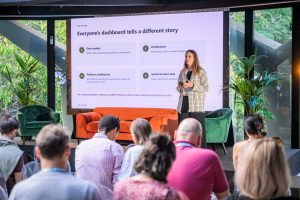
A months-long test in Switzerland, toggling each DSP on and off in turn and watching organic installs respond, showed one partner was lifting total installs while the other was simply relabeling organic traffic as its own.
An in-house marketing-mix model confirmed the pattern at scale, and Greentube cut that channel entirely in the UK and Germany: a 12% increase in first-time deposits at 6% more cost in the UK, and a 32% increase in first-time deposits at a lower marginal cost in Germany, once the budget moved to channels that were adding new installs, not just relabeling traffic already there. Her closing line: question the dashboard before trusting it, on clicks or impressions either one.
An AI-in-Growth Panel Agrees on the One Job That Still Has to Stay Human
Xavier Bourlard, SVP Global Media Partnerships at Rocket Lab, closed out the day moderating Isabelle Lejeune (CMO, Joko), Tetiana Hryshchenko (CMO, Memowrite), and Svetoslav Grigorov (ASO Manager, Scopely) on where AI has changed daily work this year.

Joko’s team built an internal agent that lets any employee, not just engineers, ship small product changes directly, with a developer reviewing the change before it goes live.
Rocket Lab’s own creative pipeline now scrapes competitor ads, routes winning concepts to AI tools for static, UGC, and motion variants, and feeds performance data back in automatically, a gain all three speakers trusted more on productivity than on actual performance, since platform algorithms keep demanding more creative volume just to hold the same results.
Every panelist landed on the same closing point: AI can draft, resize, localize, and analyze faster than any team could alone, but the decision about what ships, and who answers for it, has to stay human.
The Day Didn’t End When the Last Session Did
Once the Main Stage closed for the day, the room stayed on-site for the Barcelona Social After Party, drinks and light bites on the terrace with the same city views the sessions had been running against all day, with Addict Mobile, Jampp, Mintegral, and RZR behind it. The same conversations from the stage kept going, just with a drink in hand

Five Takeaways From the Day
Attribution still lies to you by default. Greentube’s own DSP was reporting click-through rates close to 100% before a months-long Swiss test and an in-house marketing-mix model caught it relabeling organic installs as paid ones, a fix worth 12 to 32% more first-time deposits once the channel was cut.
AI finds the problem fast, but fixing it still takes a team weeks. Rovio’s anomaly detection flagged a conversion drop in two days; tracing the code-level cause and shipping a fix took a month and a half, Martin Boccardi’s reminder that detection speed and resolution speed aren’t the same metric.
The roughest creative in the account can still be the best one. BoomBit’s top-spending creative for Mom Life has outperformed every polished variant made for the same game across two years, because a familiar, polished ad is easier for a scrolling thumb to skip in 0.2 seconds.
Checkout is moving off the App Store, and the math backs it. Paddle’s App2Web data shows a 10% average lift in lifetime value and 24% in proceeds once a subscription app adds a web checkout, a case made stronger by the EU’s October 1 fee changes.
The real fix is usually one layer upstream. TheFork’s biggest acquisition win came from product changes to onboarding. Getir’s biggest efficiency win came from targeting by income and shopping behavior once food-order history stopped being available. Product Madness’s biggest monetization win came from reordering a signup screen.
The full App Growth Summit Barcelona Insider Report 2026, all thirteen sessions broken down slide by slide, lands soon for anyone who wants the complete set in one place.
Check the full App Growth Summit event calendar for what’s coming next, and browse the App Growth Articles library for the rest of this year’s recaps and articles!