Web-to-App Funnels: Where Web Checkout Pays Off for Subscription Apps
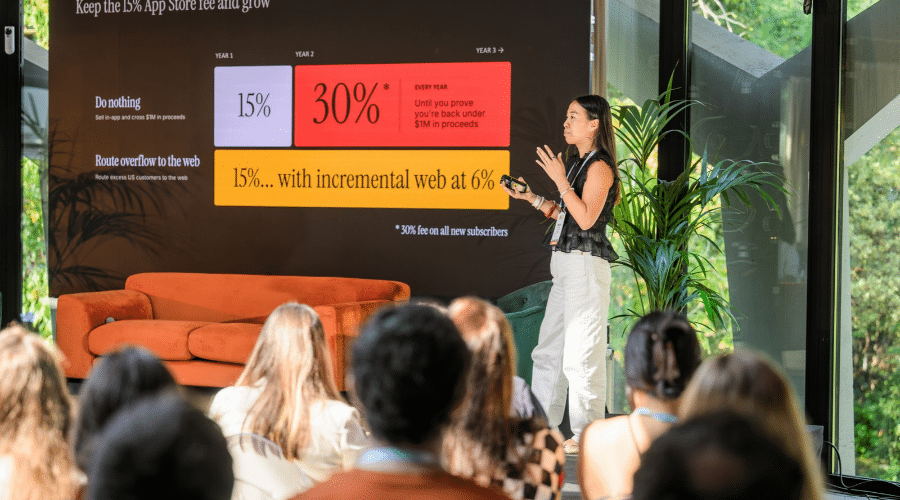
A web-to-app funnel moves part of a mobile app’s journey, usually onboarding or checkout, onto the web. For subscription apps it can bring platform fees down from 30% to single digits and hand the team control of pricing, payment methods and retention. The trade-off is a small drop in conversion and new work on payments, tax and compliance.
If your team spent part of this year asking whether checkout should leave the App Store, you’re in good company. The question came up again and again at App Growth Summit in 2026, and the most useful answers came from people who had already built the funnel, broken it and fixed it.
Key takeaways
- Web checkout typically costs 5 to 12% in conversion and returns about 10% more lifetime value and 24% more proceeds, according to data shared at App Growth Summit Barcelona 2026.
- Apps close to Apple’s $1M Small Business Program threshold have the clearest case: routing revenue above the line to the web keeps the 15% rate on everything else.
- Funnels convert best when they target high-intent users, keep the handoff to as few screens as possible and offer Apple Pay at checkout.
- Product-market fit comes first. A cheaper checkout helps an app people already want to pay for.
What is a web-to-app funnel?
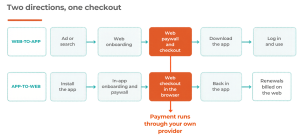
A web-to-app funnel is any growth flow where a mobile app uses the web for part of the user’s journey and the app for the rest. Teams use the term for two directions:
- Web-to-app. A user finds the product through an ad, a search or a social post, completes onboarding and pays on a web page, then downloads the app and logs in.
- App-to-web. A user who already installed the app reaches the paywall, taps through to a checkout in the browser, pays and lands back in the app.
In both cases the payment runs through the company’s own payment provider, so the app store’s commission shrinks or disappears, depending on the market. Most of the user experience stays where it was.
“Your app completely stays the same. The way you distribute it stays the same. What actually changes is that your checkout moves onto the web.” (App Growth Summit, Barcelona, 2026)
The App Store listing, search visibility, ratings and auto-updates carry on as before. In-app purchases stay available on the paywall, existing subscribers stay on Apple billing, and new subscribers choose how they pay. A web funnel adds a channel next to the App Store, and nobody has to migrate.
Why are web-to-app funnels growing in 2026?
Two rule changes opened the door, one in the US and one in the EU.
In the US, a court order in April 2025 required Apple to let apps link to web purchases without charging a new commission on them.
In the EU, new terms took effect on October 1, 2026. Apple’s standard in-app purchase fee dropped from 30% to 26%, a web purchase made through a link now costs 15%, and developers can run web checkout while keeping App Store distribution.
Other markets are opening one by one, with Brazil, Japan and South Korea named on stage at App Growth Summit Barcelona 2026.
The US rate may still change. A December 2025 appeals ruling said Apple can charge a reasonable commission on linked-out purchases, and in August 2026 Apple proposed 15% for standard apps. The district court still has to set the final figure, so model your funnel at both 0% and 15% before you commit.
Adoption has moved fast anyway.
“About 41% of all top-grossing US apps are taking revenue on the web.” (App Growth Summit, Barcelona, 2026)
Skeptics are shifting too. On a monetization panel at the same event, one product lead admitted he’d doubted the savings would outweigh the conversion drop, until case studies from much larger app companies showed fee savings in the region of $100 million a year at their scale. His team is now looking at adding web payments next year.
What does moving checkout to the web cost, and what does it return?
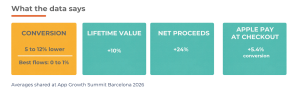
On average, apps that add web checkout lose some conversion and gain more than they lose in lifetime value and proceeds. These are the figures shared at App Growth Summit Barcelona 2026, drawn from apps that had already made the move:
- Conversion rate: 5 to 12% lower on average. The best flows lose 0 to 1%.
- Lifetime value: about 10% higher on average.
- Net proceeds: about 24% higher on average.
- Apple Pay at checkout: 5.4% higher conversion than checkout without it.
Lifetime value rises because two things change at once. The app keeps more of every payment, and it gains control of retries, offers and win-back campaigns that the App Store doesn’t allow (more on those below).
“From that first month, you’re already going to start seeing higher net revenue per subscriber.” (App Growth Summit, Barcelona, 2026)
How the fees compare
| Where the subscriber pays | US | EU (from Oct 1, 2026) |
|---|---|---|
| App Store in-app purchase, standard rate |
30% |
26% |
| App Store in-app purchase, Small Business Program |
15% |
Reduced rate applies |
| Apple’s commission on a web purchase through a link |
0% today, Apple has proposed up to 15% |
15% |
| Payment processing on the web |
About 5 to 7% |
About 5 to 7% |
The processing range comes from the web payments session at App Growth Summit Berlin 2026. Your exact rate depends on your provider and on whether it acts as merchant of record, the setup where the provider takes legal responsibility for sales tax, fraud and disputes on your behalf. EU apps also take on monthly transaction reporting to Apple, due within 15 days of each month’s end.
The $1M Small Business Program threshold
Apple’s Small Business Program charges 15% on App Store proceeds under $1M a year. Once an app crosses $1M, it moves to the 30% standard rate and stays there every year until proceeds fall back under the line. Most growing apps never go back.
The workaround shared in Barcelona is simple: keep App Store proceeds just under the threshold and send the rest to the web.
“What we suggest our customers do is you take all of your overflow onto the web, and that means that you can stay on the small business program.” (App Growth Summit, Barcelona, 2026)
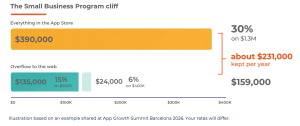
Here’s how that plays out for an app on track for $1.3M in proceeds, using the example from the session:
- Everything through the App Store: in a year at the 30% rate, $1.3M pays about $390,000 in commission.
- $900,000 through the App Store at 15%, $400,000 on the web at 6%: about $135,000 plus $24,000, or roughly $159,000 in total.
That’s about $231,000 a year back into the business. Treat the figures as an illustration, since your rates and your split will differ.
Which apps should test a web-to-app funnel?
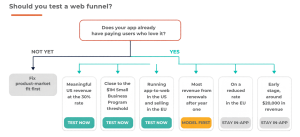
A web funnel pays off fastest for apps with meaningful revenue on Apple’s standard rate, and for apps about to cross the $1M Small Business Program line. Very small apps and apps that live on long-term renewals should model the numbers first.
“The question isn’t App Store versus web. It’s: where does web checkout make sense for my business?” (App Growth Summit, Barcelona, 2026)
| Your situation | What to do |
|---|---|
| Meaningful US revenue through Apple in-app purchases at the 30% rate |
Worth testing |
| Close to the $1M Small Business Program threshold |
Strong candidate. Route proceeds above the line to the web |
| Already running app-to-web in the US and selling in the EU |
Worth testing in the EU |
| On the Small Business Program or another reduced rate in the EU |
Stay in-app for now |
| Most revenue comes from renewals after a subscriber’s first year |
Model it first |
| Early stage, around $20,000 in revenue |
Probably too early |
Games follow a slightly different logic. One game growth lead on the Barcelona monetization panel described a web store as a retention tool for their most engaged payers, who get better value on the web and talk about the offer inside the community.
“It doesn’t work on all genres and it doesn’t work on all games, and you need to have really highly engaged users.” (App Growth Summit, Barcelona, 2026)
One more check belongs before any of this. Industry data presented at App Growth Summit Berlin 2026 showed the top 10% of subscription apps capture 95% of all subscription revenue, and most of the rest never pass $1,000 in total revenue. When an app isn’t making money, the cause is usually product-market fit, and a new checkout won’t change that. Web payments start to matter once people already want what you’ve built.
How do you build a web-to-app funnel that converts?
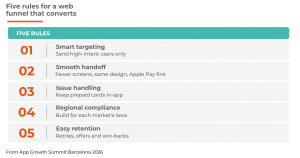
The teams getting the strongest results follow five rules: target the right users, keep the handoff short, catch risky payments early, design for each market’s laws and use the retention tools the web unlocks. On top of those, they test the web paywall as hard as any in-app paywall.
1. Send the right users to the web
Every user doesn’t need to see web checkout. Users who have finished onboarding or come back to the paywall several times show the strongest intent, and they convert better on the web than first-time visitors. Someone who opened the app a minute ago from an ad is a poor candidate. In the setup shown in Barcelona, routing decisions used session count, trial day, paywall history and depth of usage.
2. Keep the handoff short and familiar
“Every extra screen in your flow is going to impact your conversion.” (App Growth Summit, Barcelona, 2026)
The web checkout should look like the app, with the same design, colours and copy, because a page that looks like a different company makes people hesitate. Offer Apple Pay as the first option and a card form as the fallback. The best flows take a user from the paywall to a one-tap Apple Pay sheet and straight back into the app.
3. Catch risky payment methods before checkout
The App Store processes payment methods that many web processors decline, prepaid cards above all. When signals suggest a user will pay with one, keep that user in-app and send failed web payments back to in-app purchase, where the subscriber still converts, at the 30% rate.
4. Design for the rules of each market
“You can’t just build one app-to-web flow and assume that it’s going to work everywhere you go.” (App Growth Summit, Barcelona, 2026)
California’s Automatic Renewal Law requires specific disclosures before a subscription starts, so the flow needs a clear confirmation of what the user will pay and when. Apple’s new EU terms add monthly transaction reporting. Plan the compliance work market by market before launch.
5. Use the retention controls the web gives you
On the web, the app owns the whole subscriber lifecycle. It can retry failed payments on its own schedule, reach at-risk subscribers directly with an offer, build its own cancellation flow and run discounted win-back campaigns for people who won’t renew at full price. Win-back automation and dunning together recover 25 to 30% of churn, according to the Barcelona session.
The Berlin sessions added two lessons here. One team generated roughly $500,000 a year in extra revenue by tightening its failed-payment and refund rules, without spending more on ads. And most chargebacks come from confused customers who go to their bank before they contact support, so clear billing and an easy way to reach a human prevent more disputes than fraud rules do.
Test the web paywall like any other paywall
Paywall tests presented at App Growth Summit Barcelona 2026 came from in-app paywalls, but they make good starting hypotheses for a web paywall too:
- Multi-page onboarding paywalls converted 37% better than single-page ones across more than 40 million paywall views, because they leave room to tell the product’s story.
- A paid 30-day trial converted 25% better than a free trial across 250 apps that ran both offers. Users get more time to see the value, and they’ve already invested something.
- Fewer plan options worked better during onboarding, when users have already spent a lot of effort getting through the flow.
- A monthly price set at roughly a quarter of the yearly price made the yearly plan look like the better deal and lifted yearly plan share.
- Collect at least 500 trials per variant, then pause the test and let every trial mature before reading the result.
“What matters a lot is the experiment velocity.” (App Growth Summit, Barcelona, 2026)
How do you keep a web funnel within App Store rules?
Staying compliant comes down to five habits: offer in-app purchase next to every web option, use an external browser for checkout, resubmit for review after big billing changes, present prices honestly and make cancelling easy.
- Always offer in-app purchase alongside the web option. It’s one of Apple’s core requirements.
- Prefer an external browser flow over an in-app web view. Web views get approved sometimes and rejected other times, depending on the reviewer.
- Resubmit the app for review after any major change to billing or pricing.
- Avoid deceptive billing or UX patterns. Apple now looks at how pricing and subscriptions are presented, as well as where the payment happens.
- Make cancellation easy to find. A product lead on the Barcelona monetization panel warned that apps have been removed from the App Store for hiding how to cancel.
Many teams also worry that sending users to the web will cost them App Store featuring or rankings. The answer from the stage was clear.
“They’re not supposed to treat an app that takes users onto the web, in jurisdictions where that’s allowed, any differently to somebody who’s staying entirely in app. And we haven’t seen any cases of this.” (App Growth Summit, Barcelona, 2026)
The heavier cost is operational. When the payment leaves the App Store, so does the support work Apple used to do.
“Whenever you bring web payments, it’s not as easy as [connecting your usual subscription tools]. You need to take care about refunds, chargebacks…” (App Growth Summit, Barcelona, 2026)
That panelist’s previous company ran a separate team just for web payments. Working with a merchant of record moves much of that load to the payment provider.
What should you measure in a web-to-app funnel?
Measure net revenue per subscriber after every fee, and compare it with an in-app control group of new subscribers. Conversion alone will make the web look worse than it is.
- Conversion rate change between web and in-app checkout for the same audience
- Lifetime value and net proceeds per subscriber, after store commission and processing fees
- Payment success rate, including the share of declined and prepaid cards
- Refund and chargeback rate
- Recovered revenue from retries, dunning and win-back offers
- Early cancellations, the share of new subscribers who turn off auto-renew in their first 3 to 7 days, a useful early read on renewals
Roll out to a small share of eligible users first, then scale. Keep the routing remotely configurable, so you can switch the funnel off within minutes if results dip.
Frequently asked questions
What is the difference between web-to-app and app-to-web? Web-to-app funnels acquire and charge users on the web before they download the app. App-to-web funnels send users who already have the app to a web checkout, then bring them back into the app.
Does Apple take a commission on web purchases? In the EU, Apple charges 15% on web purchases made through an in-app link, from October 1, 2026. In the US, Apple currently charges no commission on linked web purchases, though it has proposed up to 15% and a court is still setting the final rate.
Will sending users to the web hurt App Store featuring or rankings? Apple isn’t supposed to treat apps that offer web checkout differently where it’s legal, and speakers at App Growth Summit Barcelona 2026 said they had seen no cases of it.
How big should an app be before it adds web checkout? Apps approaching or above $1M in yearly App Store proceeds are the strongest candidates. An app earning around $20,000 is usually better off staying in-app for now.
Do existing subscribers have to move to the web? No. Existing subscribers stay on Apple billing, and in-app purchase stays on the paywall. Only new subscribers get the choice.
The conversation continues in the room
Web funnels reward teams that treat them as a product, with their own roadmap, tests and owners.
Everything in this guide came from people doing that work week to week and sharing it openly with peers in the same seats. Many of them will be back in 2027, along with new faces who’ve just started building.
If you’re working through this now, the fastest way forward is a conversation with someone a few steps ahead.
Check out for more app monetization pieces in the App Growth Articles library, then pull up a chair at an upcoming App Growth Summit event and request your invite!