
Insights from AGS Berlin – Your Visibility Problem Might Be a Product Problem

A ranking drop rarely starts as a ranking drop. A product issue slips in first: onboarding stalls somewhere it shouldn’t, a feature ships with more friction than intended, a release introduces a bug nobody catches in time. Retention dips next. Reviews and ratings follow a few weeks after that. Only then does the store’s own ranking system read those declining signals as a quality problem and pull back visibility to match. By the time anyone opens a dashboard and calls it a discovery problem, the real cause is 3 steps removed and nowhere near the store listing.
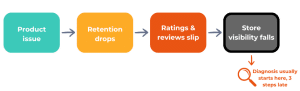
That gap matters because most teams still treat visibility, conversion, and product fit as three separate diagnoses, when in practice they run through each other constantly.
Getting discovery right now depends on reading that whole chain correctly, on knowing what you’re selling, on treating markets as different businesses instead of translated copies of one, and on knowing when a personalization tool is solving the real problem versus dressing up a symptom.
“A product problem rarely announces itself as a product problem. It shows up first as a ratings dip, then a visibility drop, and by the time it reaches the store listing, most teams are already diagnosing the wrong layer.” AGS Berlin 2026
What You’re Selling Decides How People Find You
An app and a game can sit in the same store, ranked by the same algorithm, and still need almost opposite playbooks. An app is usually solving a stated problem: someone wants a workout tracker, a delivery app, a place to book a flight, and they arrive already knowing roughly what they need. A game rarely works that way. Nobody opens the store looking to solve a pain point, they’re chasing a mood, and figuring out what mood a specific game satisfies is a genuinely harder question than reading a search term.
That difference cascades into how each gets discovered. Apps lean on search, because search only works when the person searching already knows what they want. Games lean harder on browse, editorial collections, and “you might also like” placements, because that’s where someone without a defined intent gets matched to something. It shows up in creative too: an app’s creative earns attention by showing functionality fast, closer to a restaurant’s menu posted outside the door. A game’s creative has to convince someone they’re in the mood for what’s being offered before they’ve even opened the menu.

Testing Doesn’t Start With Your Biggest Market
A company running in dozens of markets can’t treat every one of them the same, and the instinct to test in the market with the biggest revenue first is usually the wrong one. If a test goes badly in the market carrying most of the business, that’s an expensive way to learn something.
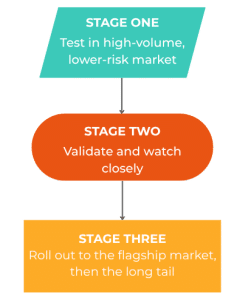
The safer path is testing in a second-tier market first, one close enough culturally to be a fair proxy, big enough in session volume to reach statistical significance quickly, then rolling a validated result out to the flagship market under close watch, with the long tail of smaller markets picking it up last.
That doesn’t mean results travel cleanly just because two markets share a language. A test that succeeds in one English-speaking market can still land differently in another, since the variable was never really the language, it was the audience’s habits and expectations. Controlled, staged rollouts exist precisely because that gap is real, not because the tiering system removes the need for caution.
Real localization goes well past translated copy, and treating it as a language exercise is one of the more expensive myths still floating around the industry. The actual differences that move conversion are structural: what payment methods a market expects, whether delivery shows up at the door or gets picked up from a locker, what the underlying offer even needs to be to match local weather, geography, or habits. None of that shows up in a translated string, and none of it gets fixed by better keywords.
Prioritizing which markets get that level of attention comes down to a fairly simple exercise: estimate lifetime value per market, apply something close to the 80/20 rule to find the short list that moves revenue, then go one step further and calculate what a modest conversion lift, even two percentage points, would be worth in that market specifically.
That number turns a debate about which markets deserve investment into a resourcing decision decided by revenue, which also happens to be the argument every other team in the building already understands.

Custom Listings Only Work If the Diagnosis Is Right
Custom store listings are one of the more useful tools available for this kind of targeted work, and also one of the easiest to point at the wrong problem. They can be built around a specific market, a specific search term, or even a specific stage a user is already in, and the most useful ones do double duty: they keep the experience consistent from ad creative through to the store page, which is also what ad platforms reward with better delivery.
The catch is that more surface area for personalization is also more surface area to waste effort on, and a custom listing built to fix a conversion problem does nothing if the real issue traces back further, to retention, to reviews, to the product itself.

The Product Is the Strategy Now
Store algorithms have moved well past matching keywords, and building a listing around stuffed metadata is a losing strategy against systems now reading for intent and relevance instead. What a product says about itself carries far less weight than what everyone else is already saying about it: reviews, community mentions, coverage, the accumulated signal sitting outside the store listing entirely. Roughly half of all search results today end without a click at all, one more sign that the surface area worth optimizing has moved beyond a page any team fully controls.
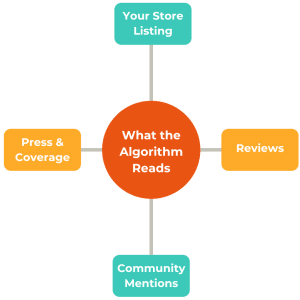
“To a search system built on AI, what a product says about itself barely counts as evidence. What actually moves the needle is what everyone else is already saying about it.” AGS Berlin 2026
Which is really the whole argument in one place: the algorithms are reading the product, the reviews, and the reputation before they ever get to rewarding a clever page, so the store listing was never going to be where a real discovery problem got solved.
Treating technical stability as part of that same growth responsibility, staying off Friday releases, rolling out gradually instead of all at once, follows the same logic, since one bad rollout can cost months of visibility that no amount of listing optimization gets back quickly.
The teams that keep winning discovery from here are the ones who stopped treating the store page as the whole job and started reading it as the last domino in a much longer chain. The same kind of conversation plays out live too, at invite-only events that rotate to a new city every few weeks. Check the App Growth Summit event calendar and request your invite now!