
Is Performance Marketing Becoming Too Automated?
Every performance marketing team already uses AI. What’s changed is how much of the work now runs through it: bidding, reporting, creative variants, entire pieces of campaign management.
The real question isn’t whether this job is becoming automated. It already has. It’s whether that’s the same thing as being too automated, and the teams getting it right aren’t the ones who’ve handed off the most.
One growth team found that out the hard way. Their own automation flagged their highest spending campaign for an emergency pause, and they had to decide, in the moment, whether to trust it.
Producing Context Is Becoming the Real Job
A creative-analytics platform that processes over a billion dollars of ad spend a year, recently spent a day watching one of its own engineers work, just to see how the job had changed.
He came in with three feature requests waiting and didn’t open his code editor once. Instead he spent the first 90 minutes of his morning talking to an AI agent, walking it through where to find the relevant code, what it needed to do, and every edge case he already knew about.
Three separate agents then went and built it. He spent the rest of the morning answering their questions and approving what they’d shipped.

The second half of his day was the more telling part. He wasn’t writing code there either. He spent it documenting what each of the company’s four hundred internal tools does, so an agent could pick the right one for a task, and writing up the exact sequence of steps for handling specific situations, so future agents wouldn’t have to guess twice.
When a bug showed up in production, his first move wasn’t to fix it. It was to figure out which wrong assumption the agent had made that caused it, correct that assumption instead, and let the agent re-run the fix on its own.
Add it up and he spent under 30 minutes that day writing code. Nearly everything else went into giving an AI system the context, memory, and instructions it needed to do the work itself. The company’s co-founder, who ran this shadowing exercise personally, expects the same shift to hit user acquisition and creative teams next, less time producing the ad, more time producing the system that produces the ad.
This transition is already demonstrating tangible impact. Meta has said publicly that more than half of its ad auctions are now decided by creative alone, not targeting or budget. Full creative pipelines, the kind that used to require a research team, an ideation team, and a dedicated production team working in sequence, are now something a much smaller advertiser can run. The advantage that used to belong only to companies with the biggest budgets is starting to belong to whoever built the better system.
Automation Comes Before AI, Not After
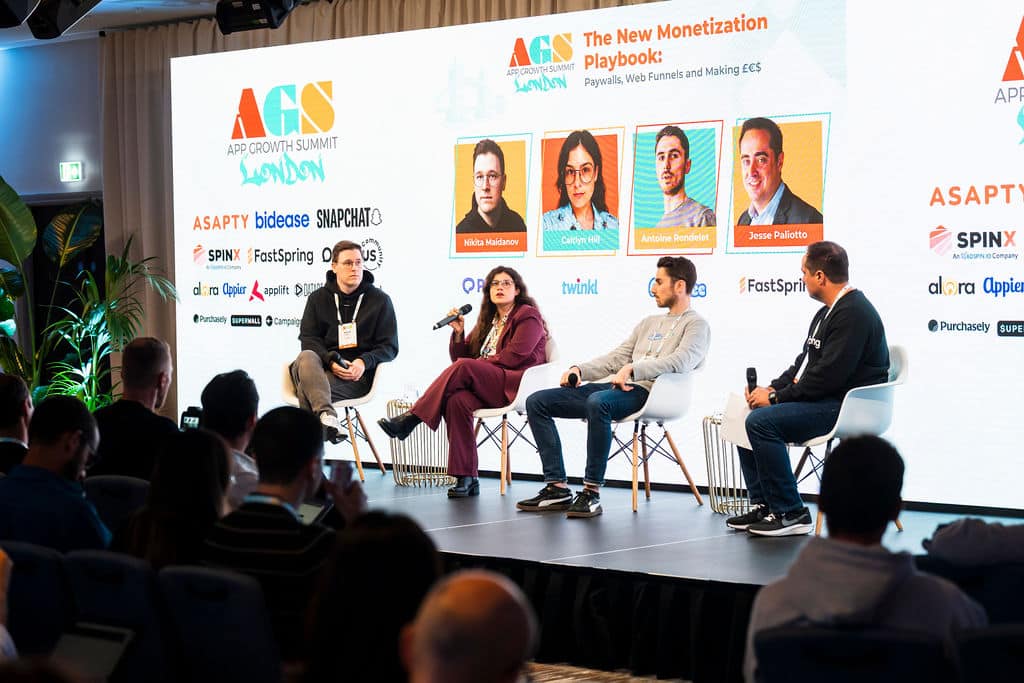
Not everything that gets automated needs AI. A panel of growth leads at a recent App Growth Summit session highlighted a crucial distinction regarding lean-budget growth that deserves careful consideration.
“Keep in mind, the issue with AI is you ask it twice the same question and you get a different output. Every time you have something that’s deterministic, your best way to go is probably just automating it. Once you’ve figured that out, that’s when laying an AI layer on top is the most impactful. But don’t start there. First go here.” AGS Berlin 2026, Utilizing Your Euros.
Two of the least significant examples on that panel turned out to be some of the highest-leverage.
One team built simple automated checks into refunds and failing payments, testing whether the company was being too generous with the former and losing revenue to preventable card failures on the latter, and generated roughly $500,000 a year they weren’t collecting before.
Another pushed CRM messaging frequency far more aggressively than felt comfortable in the first days after signup, since that’s when engagement runs highest, and treated the lift as free revenue because it never touched the paid acquisition budget.
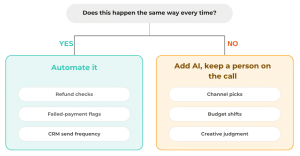
None of that needed judgment. It needed someone willing to build the automation and test how far it could go. The decisions that still needed a person looked different. There’s the question of which new channel is worth testing, once reach, measurability, and scalability all line up before a dollar goes in.
There’s whether a cost-per-install number that looks great is translating into revenue once retention and lifetime value get factored in. And there’s how much overlap exists between what a new channel brings in and the users who would have shown up anyway. Those are judgment calls stacked on incomplete information, and no one on that panel treated them as something to hand off.
AI Lacks Awareness of Day-to-Day Context Shifts
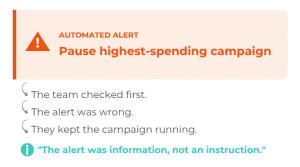
The same panel offered the clearest cautionary story of the day. One team’s automated monitoring flagged their highest-spending campaign, the one carrying the biggest share of their budget, for an emergency pause.
The alert kept firing. The team’s instinct was to stop and check what was happening before acting on it, and it turned out the system was reacting to a pattern that looked alarming on paper but wasn’t actually a problem. They left the campaign running. Had they let the automation act on its own, they’d have paused their best-performing channel over nothing.
That’s the boundary the panel kept returning to from different angles. AI doesn’t know what a company is trying to achieve this quarter. It doesn’t know a customer the way someone who’s been reading their support tickets for two years does. It has no way of knowing a competitor just dropped out of a category, a platform changed a policy overnight, or a metric moved for reasons unrelated to the campaign. It can flag a pattern. It can’t tell you whether that pattern means something went wrong, or whether today is simply different from yesterday for a reason it can’t see.
That’s not a case for turning it off. Every team on that panel was already running AI on data analysis, predictive modeling, and creative-performance review, in one case with a team of three doing what used to take a much larger group.
It’s a case for treating the alert as information rather than an instruction. The system that catches a real problem and the system that misreads a normal fluctuation look identical from the inside. The only way to tell them apart is a person who already knows what normal looks like.
Context is the Differentiator
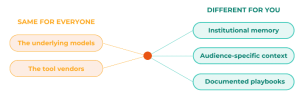
Here’s the part that should change how a team thinks about its own advantage. The underlying AI models are converging fast, and every team will eventually have access to roughly the same ones.
The tools built on top of them are converging too, since most companies land on the same handful of vendors after a quarter of evaluating options. Neither of those is where a real edge comes from anymore.
“The quality of the output is determined by the quality of the context assembled before the AI call, and the recipe is written to use that context.” AGS New York 2026, Building a Creative Hit Machine with Agents.
Most of the job now, in other words, is assembling that context well and writing the playbook that uses it. What doesn’t converge is what a team feeds the system. That’s its own institutional memory of what has and hasn’t worked, the specific context about its audience and brand, and the documented playbooks for how it handles recurring situations. Two competitors can point an AI agent at the exact same market and the exact same public data and still get different, better, or worse output, because the agent is only as good as what it already knows about that specific business.
There’s a real difference between storing a fact and storing a reason. That a specific creative pulled a 2.1x return on ad spend is a fact, and on its own it doesn’t help the system make a smarter call next time. What’s useful is the reason behind it.
Messaging built around trust worked on that audience because they carry high purchase anxiety, and an agent that can query that reasoning applies the same logic the next time it builds for a similar audience, instead of just re-running the exact same creative. Writing memory that way, as reasoning instead of outcomes, is quickly becoming its own skill.
That’s also why the role itself is shifting. The people getting the most out of this aren’t necessarily the best prompt writers. They’re the ones deciding what context an agent should have access to, what’s worth remembering out of everything an agent produces in a given week, and what the documented right way to handle a given scenario looks like. The job is moving away from running the campaign by hand and toward building the system that runs it well, the same shift already showing up everywhere else in the business.
So, is performance marketing becoming too automated? The honest answer is that it’s becoming automated faster than most teams have caught up to, and that’s a different problem to solve. The teams handling it well aren’t resisting automation. They’re deciding, deliberately, which specific calls stay theirs, and building the memory and context their AI systems need to handle everything else.
Every example in this piece came from a leader who said it out loud on an App Growth Summit stage this year, in a room full of people wrestling with the exact same question.
Check the App Growth Summit event calendar to see where the next one lands, and request your invite to sit in the room for the next round of these conversations yourself!