ASO Myths That Are Still Costing Teams Installs with Shoham Lachkar

ASO has operated for years on a set of assumptions that made sense when search meant typing into an app store and scrolling the results. That’s no longer the whole picture.
AI assistants now sit between a search and a store listing, recommending apps directly, and some of the practices teams still treat as standard were built for a search landscape that has already moved on.
We put this piece together with Shoham Lachkar, who has spent more than a decade in ASO, running it inside app teams across dozens of titles before turning her focus to how AI systems evaluate and recommend apps. Here are eleven of the assumptions she runs into most, and why each one is still costing teams installs.
Here’s where one of those assumptions starts to break down, in a scenario every app team will recognize.
A parent wants to find an educational game for their child. A few years ago, the obvious first step might have been opening the App Store or Google Play and typing “educational games for kids.” Today, that same parent may start somewhere completely different. They might ask ChatGPT, Gemini, or another AI assistant: “What’s the best educational game for kids?”
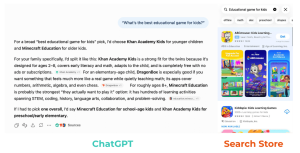
The assistant responds with a handful of recommendations. The parent chooses one, and only then reaches the app store.
At App Growth Summit Berlin 2026, a session on AI-era app discovery walked the room through a real example, the same app ranked first in a Play Store search and third in ChatGPT’s answer to a nearly identical question, and its position shifted again depending on exactly how the question was phrased. Two different systems, two different answers, one app.
The practical implication is that teams now have two separate rankings to track, not just one. There’s how the app ranks in each store’s own search results, and there’s how often and how favorably AI assistants describe it when someone asks a related question in plain language. A strong position in one says nothing about the other.
That small change in behavior represents something much bigger for app growth teams. Discovery is becoming more fragmented, while ASO’s job is becoming broader.
At the same time, teams have more tools, more data, and more AI than ever before. Yet many assumptions that shaped ASO for years still influence how apps launch, localize, promote, and optimize.
Discovery Now Starts Before Anyone Opens the App Store
One of the biggest myths in ASO today is that ASO ends inside the app stores.
The App Store and Google Play are obviously still critical discovery environments. But they are no longer the only places where someone may begin searching for an app. That parent asking for the “best educational game for kids” may receive a shortlist from an AI assistant before they ever see a traditional search result.
For apps, this creates a new challenge because apps start at a structural disadvantage compared with many web-first businesses.
A web product can have dozens or hundreds of publicly accessible pages explaining what it does. It may have feature pages, use cases, FAQs, comparisons, tutorials, help-center content, customer stories, articles, reviews, press coverage, and third-party references.
An app may have an App Store listing, a Google Play listing, and a relatively basic marketing site. Meanwhile, much of the information that makes the product valuable is trapped inside the app itself. The onboarding flow is inside the app. The features are inside the app. The content is inside the app. The user experience that makes the product different is often invisible until after installation.
That means the public information footprint explaining to search engines and AI systems what the app does, who it is for, and when it should be recommended may be very thin. This is why I think app companies need to start thinking about two connected forms of visibility.
- Store discoverability: Can someone find and convert on your app inside the App Store or Google Play?
- AI discoverability: Is there enough accessible and credible information about your app for an AI system to understand when it belongs in the answer?
That means building a web footprint around the product. Use-case pages, FAQs, comparisons, category content, problem-focused content, and clear product information can all help explain what the app should be associated with.
This is exactly the challenge we’re addressing with Appeak Pro. Traditional ASO helps apps compete for visibility in the App Store and Google Play, but AI assistants represent an entirely different discovery environment. Many apps are at a disadvantage because the information explaining their features, value, and use cases isn’t sufficiently accessible to the AI systems making recommendations.
At Appeak Pro, we’re working to close that gap by actively building an AI-discoverability layer for mobile apps. We create and continuously optimize dedicated, publicly accessible content hubs that connect an app’s capabilities to the real questions people ask, giving AI assistants more relevant information to discover, understand, and reference when recommending solutions.
One of the recent success stories involves a health-focused ingredient-scanning app we’re still working with. We’ve been expanding its web presence with structured content that targets specific consumer needs, including identifying unwanted ingredients, finding healthier grocery alternatives, and comparing ingredient-scanning solutions.
The results are already tangible. The app has reached the #1 recommendation position in monitored ChatGPT responses for a query about alternatives to a well-known competitor. Claude has also ranked it #1 for several related questions, including clean-ingredient barcode scanning and identifying potential hormone disruptors.
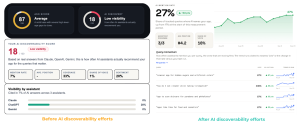
These are real visibility wins from an ongoing optimization effort. While AI responses fluctuate and we can’t isolate the impact of any single change, we’re already seeing the app earn recommendations across relevant user questions beyond traditional app store searches. Our work now focuses on expanding that visibility into additional queries and strengthening its consistency over time.
This highlights an important evolution in organic app growth: Traditional ASO helps people find apps when they search for products, while AI discoverability helps apps become part of the answer when people search for solutions. But the store listing still matters, even as app discovery expands beyond the stores.
That same App Growth Summit Berlin 2026 session pointed to research showing that roughly half of the citations AI tools pull when they describe or recommend an app trace back to its store listing, so the listing now does double duty, feeding the store’s own search results and the AI systems that cite it as a source.
That double duty changes what good listing copy actually looks like. An AI system pulls from the same text a shopper reads, so metadata written to satisfy a keyword checklist gives it less to work with than metadata that plainly states the problem the app solves and who it’s for. The listing has effectively become the app’s FAQ answer for two different audiences at once.
This can also run in a direction a team doesn’t fully script. A language-learning app added an accent-coaching feature at a separate session on AI product recommendations, and AI models started recommending it for accent practice, a use case with little connection to the vocabulary-drilling reputation most people already had for it. The lesson was to check what the feature’s own language actually says, since an AI system reading it can extend a product’s positioning further than the product’s own marketing aimed it. (App Growth Summit Istanbul 2026)
It fits a broader pattern we’ve tracked across our own sessions too. More than half of searches now end without a single click, so the algorithm and the AI systems reading it increasingly weigh what other sources say about an app over what the app publishes about itself. This matters even for companies with strong brands.
Another myth I often hear is: “We already have a strong brand, so we don’t really need ASO.” Brand strength helps enormously, but branded demand mostly captures users who already know you exist. The growth opportunity is also in reaching someone who knows the problem they need solved but does not yet know your name. A strong brand captures demand. Great discoverability expands it.
Your Launch Listing Gives the Stores Their First Read on Your App
Another costly assumption is: “We’ll launch with a placeholder listing and fix the ASO later.”
You only get one first launch. When a new app enters a store, there is very little historical information attached to it. Your metadata is among the first signals the platform can use to understand what the app is and which searches it may be relevant to.
At launch, the app can begin receiving visibility around some of the concepts and terms associated with that metadata. That gives the stores their first opportunity to observe how people respond. Do users engage with the listing? Do they install? Does the product deliver on the promise that brought them there?
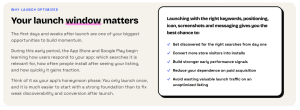
Apple and Google do not publicly disclose the exact weighting of all ranking and quality signals, so I would not present the industry’s so-called “honeymoon phase” as a guaranteed temporary ranking boost. But the underlying principle matters.
Your first launch is a unique period in which the stores are building their earliest understanding of your app’s relevance and performance.
If you launch with researched metadata, strong positioning, conversion-focused creatives, and a product ready to retain the users you acquire, you are giving the app a much stronger starting point than if you launch with placeholder assets and plan to optimize everything later. You only get one first launch. Don’t waste your first opportunity to show the algorithms where your app belongs.
ASO should therefore be part of launch preparation. Keyword research, competitor analysis, metadata, creative strategy, priority localization, and measurement should already be considered before the app goes live. And importantly, ASO cannot compensate for a product that does not deliver. The listing can earn the install. The product still has to earn the user.
We’ve already made a version of this same argument before. A well-researched launch listing can earn the install, but it cannot manufacture retention the product doesn’t deliver. When the real gap sits upstream in the product itself, no amount of pre-launch ASO work closes it. We wrote more about that here.
That’s also the useful diagnostic when a launch underperforms. Before treating it as a metadata problem to iterate on, it’s worth checking whether people who install are actually sticking around. A listing that keeps earning installs into a product that can’t hold onto those users is usually pointing at onboarding and product fit as the real gap.
We’ve heard the mechanism spelled out on our own stage too. A product issue lowers retention, which lowers ratings and reviews, and the store’s own ranking system reads that drop as a quality signal and cuts visibility in response. By the time a team calls it a discovery problem, the real cause is usually a few steps removed, back at the product itself.
Every Store and Every Market Is Its Own Search Problem
Another common shortcut is: “It’s the same app, so I’ll use the same metadata on iOS and Android.” The product may be the same. The search environments are not.
Copying the same strategy between stores ignores the differences between them and their ranking algorithms.
The same problem happens across countries. “Localization just means translating my English listing.” It does NOT. Translation changes the language. Localization changes the strategy.
A weak localization test result often traces back to a business-model gap, missing local payment methods or delivery preferences the market actually expects. Worth ruling that out before concluding a market simply isn’t worth the investment, since the listing’s wording may not be the actual problem. (App Growth Summit Berlin 2026)
Users in different markets may describe the same problem differently. Search demand can be different. Competition can be different. Cultural references can be different. Even which product benefit is most persuasive can change.
A translation can therefore be linguistically perfect and still be strategically wrong.
And that leads to another assumption: “The US is our main market, so that’s the only market worth optimizing.” Sometimes that becomes a self-fulfilling cycle.
The US receives the strongest metadata, the most creative testing, the most localization resources, the largest UA investment and the most attention. It performs best, which then becomes evidence that the US deserves even more investment. But sometimes: Your biggest market is your biggest market because it’s the one you’ve invested in most.
There may be markets where the search opportunity is less competitive, where a small conversion lift is more valuable than expected, or where local optimization unlocks demand the English listing never captured. Making an app available globally is not the same as optimizing it globally.
This is also the shape of a mistake we hear about often on our own stage. At App Growth Summit Berlin 2026, panelists on the Age of AI discovery session pointed to teams testing a change in a high-volume, lower-risk market before rolling it out in their flagship market, and warned against assuming results transfer even between markets that share a language. The same session paired that with a simple prioritization exercise worth borrowing here, ranking markets by LTV using a Pareto lens and asking what a 2% conversion lift would actually be worth before deciding where to spend localization effort next.
Your Store Page Decides What Your Traffic Is Worth
Paid acquisition and ASO are often separated organizationally. The user does not care about your org chart. If someone taps an ad and lands on the store page, that page becomes part of the paid acquisition funnel. This is why “paid acquisition can make up for weak ASO” is another dangerous myth.
Driving more traffic to a weak product page does not solve the conversion problem. It can simply make that problem more expensive. Before scaling traffic, you should understand whether the destination actually convinces people to install.
Both stores provide tools designed to measure and improve conversion. Apple’s Product Page Optimization lets developers test alternate icons, screenshots, and previews, while Google Play Store Listing Experiments can test graphics and text against the existing listing.
The same principle applies to screenshots. A surprisingly common belief is: “My screenshots just need to look good and show my features.” Feature A. Feature B. Feature C. Nice device frames. Beautiful branding. But that is often a product tour, not a conversion story.
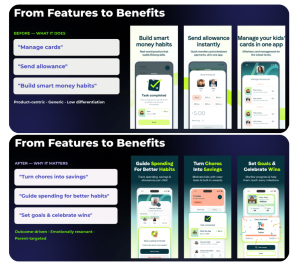
Users do not necessarily care that you have a dashboard, an AI feature, or 2,000 practice questions. They care about what those features will help them accomplish.
A screenshot should communicate value before it documents functionality. Instead of asking, “Which features should we show?”, the better question is: “What does the user need to understand in the first few seconds to want this product?”
The strongest creative tells a story about the problem solved, the outcome delivered, and the reason this app is different. The goal is not simply to show the product. It is to sell the value of the product.
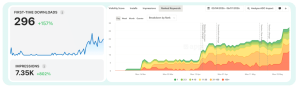
That same distinction, a product tour versus a value story, is what we heard pushed further in that App Growth Summit Berlin 2026 session, which looked at how AI systems read a listing compared with how a person scans it. The guidance there was to write descriptions like an answer that leads with the problem the app solves and the goal it helps someone reach, then turns every feature into a stated benefit, since that’s the same shape of information an AI system pulls out when it decides whether to recommend the app at all.
It’s worth noting this works the same way for the person scrolling as it does for the AI system reading the page. Both are skimming for a quick answer to whether the app fits what they need. A screenshot built to answer that question does double work, converting the human looking at it and giving the AI system a clearer signal to cite.
ASO Never Finishes, AI Helps Only When Strategy and Data Steer It
Perhaps the most persistent ASO myth is that optimization is something you eventually finish. Update the metadata. Replace the screenshots. Translate a few markets. Done. But the environment does not stop moving.
Competitors launch. Rankings shift. Search demand changes. New product features create new opportunities. Creative performance changes. New markets become important. Platforms introduce new discovery surfaces. Optimizing one app across two stores and a few markets is manageable. Now multiply that across 10, 20, or 50 apps, dozens of locales, multiple releases, creative tests, keyword movements, competitor changes, and product updates.
Even very strong ASO teams eventually run into the same problem: capacity. The biggest titles and highest-revenue markets receive the attention. Smaller apps, secondary locales, and ongoing experimentation get pushed down the queue. The challenge is often not knowing what to do. It is doing it consistently across every app, store, market, and release.
I experienced this firsthand while leading ASO at Zynga, where my team managed optimization across a large portfolio of mobile games, multiple stores, and international markets.
We had the data, tools, and expertise to identify opportunities, but execution was always the challenge. Between keyword research, metadata, creative testing, localization, and ongoing optimization, there were simply more opportunities than even a dedicated team could consistently address. We had to prioritize the biggest titles and markets, knowing that smaller opportunities often remained untouched.
This is also where the conversation around AI needs more nuance. One myth says: “AI can just do our ASO now.” AI can certainly produce metadata, localization, keyword ideas, copy variations, screenshot concepts, and competitor summaries much faster than a human doing everything manually. But generation is not the same as strategy.
A general-purpose AI model does not automatically know your live keyword rankings, current search demand, competitor movement, store-specific performance, conversion data, or business priorities. If I simply ask an AI model to “write better App Store metadata,” it can produce something that reads excellent. That does not mean it targets an opportunity we can realistically win.
AI alone can’t determine which changes are worth making. That requires expert judgment, app-specific context, and live market intelligence. And identifying the right opportunities is only half the challenge. Someone still needs to execute them.
That’s the challenge AI alone doesn’t solve. It can generate metadata, localization, and creative ideas in seconds, but understanding which changes will actually improve performance requires market intelligence, app-specific context, and expert judgment. But even knowing what to optimize isn’t enough. The real challenge is consistently turning those insights into action.
That execution gap was one of the reasons I built Appeak Pro. After years of managing ASO at scale, I realized the industry didn’t need another tool showing teams more data, rankings, and competitive insights. The real challenge was turning that intelligence into action. Appeak Pro was built to bridge that gap, combining expert ASO strategy, live market intelligence, and AI-powered execution to actually deliver the metadata, localization, and creative strategies teams need, consistently and at scale. The goal isn’t to replace ASO expertise, but to make it possible to execute across more apps, stores, and markets without sacrificing quality.
We’ve seen teams on App Growth Summit stages draw that same expertise-over-automation line in very different places depending on the stakes. One marketplace we covered kept customer support entirely human. A content-subscription publisher, facing a similar volume problem, let AI handle roughly 90% of support conversations and kept a person for the remaining 10%. Same technology, opposite call, and the deciding factor both times was a team that understood its own data and risk tolerance well enough to draw the line itself. That’s the same discipline this piece is describing for ASO, where AI moves fast and someone still has to decide when its answer is good enough to ship.
Both calls were right because each team had measured what a wrong answer would cost in that specific context before deciding how much to automate. That’s the same test worth applying inside ASO, whether the team has enough data and expertise to know when an AI-generated metadata variant or localization pass is good enough to ship without a second look.
The same applies to the myth that more data automatically means better ASO.
Most growth teams are not suffering from a shortage of dashboards. They have keywords. Competitor charts. Conversion metrics. Rankings. Market data. Testing results. The bottleneck increasingly comes after the insight.
Which opportunity matters most? What should we change first? Which market deserves resources? Which recommendation is realistic? And who is actually going to execute all of it?
That is where I believe AI can genuinely change the economics of ASO. Not by removing the expert from the process, but by allowing expert judgment to scale much further.
AI can generate the answer. It still needs the right data and expertise to know whether it’s the right answer.
ASO Is Becoming a Broader Discipline
The common thread behind these myths is that ASO is no longer just about adding keywords to an app listing.
The stores are evolving. User discovery is evolving. AI is creating new discovery surfaces. Portfolios are getting harder to operate manually. And teams have more information than ever, but still need to decide what actually deserves action.
The next phase of ASO is about connecting expert strategy, live market intelligence, scalable execution, localization, conversion, and visibility wherever users begin looking for a solution.
The storefront still matters enormously. It is just no longer the whole story.
ASO keeps moving because stores, markets, and the AI systems between a searcher and your app keep moving too, making it a live, ongoing discipline that rewards teams who keep working it over teams who worked it once. If you want more of this thinking in the room, live, request your invite for the next App Growth Summit event!
Subscribe to App Growth Snacks or check out App Growth Articles to explore more.