Automated Bidding: How Much Control Are Marketers Really Giving Up?

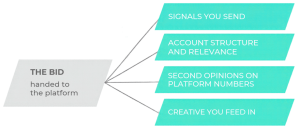
With automated bidding, marketers hand most bid-level decisions to the platform and keep control of what the algorithm learns from. That means the conversion signals they send, the account structure they build, the checks they run on platform numbers and the creative they feed in. In 2026, the strongest teams steered through those four inputs.
If you’ve run paid acquisition for a few years, you probably remember the first time a platform asked you to stop setting bids yourself and let its system decide. Clicking yes can feel like handing someone else the wheel.
Today, that’s the default almost everywhere. Target-cost and value-based bidding, broad audiences and automated placements now handle most of the work a UA manager used to do by hand.
So it’s fair to ask how much control is really left. Here’s what the answer looked like in practice.
What Should Automated Bidding Optimize Toward?
Automated bidding learns from conversion events. If those events arrive late, carry noise or measure the wrong thing, the system optimizes toward the wrong goal with complete confidence.
Automated bidding only performs as well as the tracking behind it, so fix the data pipeline before you scale spend.
One social ad platform’s bidding stack delivered a double-digit average lift in installs once signal quality held up, and clean signals alone can swing CPI by double digits (App Growth Summit San Francisco and Berlin, 2026). No amount of automation fixes what bad data feeds it.
Signal engineering is the practical version of this. One dating app studied what new users did in the first 6 to 24 hours after install, isolated the actions that predicted retention, and sent those events back to its ad platforms as the goal to optimize toward.A unified attribution test with one social platform cut its signup cost per acquisition by roughly 30% (App Growth Summit London, 2026).
That’s where a lot of the old bid control lives now. The event you choose to optimize for shapes results more than any bid you used to type in.
Why Can’t a Higher Bid Fix Falling Installs?
Automation can also hide where the real ceiling sits. The Apple Ads auction runs on installs per mille, or IPM, a relevance score built from how often people who see an ad go on to install the app.
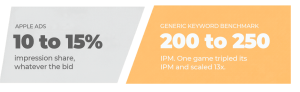
For generic keywords, a healthy IPM sits around 200 to 250. Below a certain line, Apple stops handing out impressions, however high the bid climbs.
“We always call this an invisible wall that you cannot go through if your IPM is really bad. They will keep you behind 10 to 15% of impression share, and you cannot get through this number even if you are paying $1,000 for the bid.” (App Growth Summit, Barcelona, 2026)
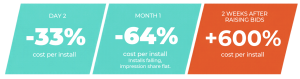
Getting this wrong can be expensive. A large betting app saw its cost per install fall 33% in two days and 64% within a month.
Installs dropped at the same time, so the team blamed the bidding, even though impression share had stayed stable the whole time. The real cause sat elsewhere.
The team had switched off its other paid channels, which dragged down branded search. They raised Apple Ads bids anyway, and within two weeks they were paying 600% more per install (App Growth Summit Barcelona, 2026).
Check impression share before you touch a bid.
The fix runs the other way. One game tripled its IPM, broke through the wall and scaled 13x.
An AI note-taking app split its keywords into clusters, built ten custom product pages around them, and finished with its highest volume at its lowest price per install (App Growth Summit Barcelona, 2026).
Apps with strong IPM can win up to 3x the impression share (App Growth Summit New York, 2026). Single-keyword ad groups remain the setup where a marketer keeps real control over bids and pages, and they make it far easier to see which keyword is breaking.
Should You Trust Platform Budget Recommendations?
Handing over the bid also means accepting a lot of numbers you didn’t produce yourself, from budget recommendations to predicted values and credited conversions. The teams that kept control treated each one as a claim to check before acting on it.
Don’t let the algorithm grade its own homework. When a platform recommends raising your budget, it doesn’t know your campaign’s specifics, so check whether LTV and payer percentage are tracking to plan before you say yes.
With conversion windows stretching to 28 days, predicted LTV leans on signals that arrive too late. Benchmark live revenue against historical data in place of trusting the model alone (App Growth Summit Berlin, 2026).
Patience is part of the same discipline. One games studio checks two things before it acts on a model that asks for more budget.
The prediction has to hold up for later cohorts, and the extra spend can’t knock the channel mix out of balance. Seasonality and ordinary model drift both look like a real signal in the short term.
“We cannot take any decision or action in one, two weeks of specific good or bad performance.” (App Growth Summit Barcelona, 2026)
Ad networks deserve the same standard. A partner that says to upload 2,000 creatives a week, spend more and trust the system gives a team nothing to work with.
A partner that explains what its algorithm is good at, such as finding high spenders, helps the team pick the right markets, creative and reporting rhythm.
“I don’t want to know your black box, how it’s working. That’s fine. But at least help me to help you.” (App Growth Summit Barcelona, 2026)
Automated reports can back every decision, and the final call still sits with a person.
“The one that’s going to press the button is a human.” (App Growth Summit Barcelona, 2026)
Platform dashboards need the same scrutiny. Two DSPs can count clicks in completely different ways, and one online gaming company saw click-through rates close to 100% before it realized the attribution itself had broken.
The first reaction was the one most teams would have had.
“We started looking at our dashboard. We said wow, they’re doing so good. So we just started throwing money.” (App Growth Summit Barcelona, 2026)
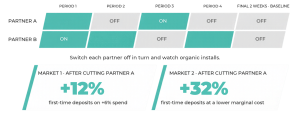
Total installs weren’t growing, so the team ran a months-long test in a small market, switching each partner off in turn and watching organic installs.
One partner was adding new installs. The other was relabeling organic traffic as its own.
After the team cut that channel in two larger markets, first-time deposits rose 12% on 6% more spend in one, and 32% at a lower marginal cost in the other (App Growth Summit Barcelona, 2026).
“The click was never the point. Question your data.” (App Growth Summit Barcelona, 2026)
Incrementality testing answers the same question in every category. A food delivery app ran more than 200 incrementality tests in four months and stopped treating ROAS as its main number, since a hungry user was always going to order from someone (App Growth Summit London, 2026).
A grocery delivery app switched off digital campaigns for its most loyal customers and saw no drop in their orders (App Growth Summit Barcelona, 2026).
Another test found that pulling back brand-search spend simply let organic traffic fill the gap (App Growth Summit San Francisco, 2026).
An algorithm will take credit for every one of those conversions, and only a test shows which ones it caused.
How Does Creative Shape Automated Bidding Results?
When you can’t set the bid, the creative you feed the system becomes one of the strongest levers you have left. It comes with its own traps.
Algorithms tend to starve the emotional, story-driven ad of spend in favor of whichever creative wins the fastest click, even though the story is often what keeps people around.
Running brand and performance creative separately gives the slower ad a fair chance (App Growth Summit Berlin, 2026).
Variety needs a real difference too. An algorithm can read two versions of the same core message as duplicates, even when they look nothing alike.
Real testing needs a new angle, beyond a new color or font (App Growth Summit London, 2026).
Deciding what counts as a win also stays with you. One consumer app studio defines a winning ad as one that drives purchases above its internal threshold on day zero.
It uses click-through and hook rates only as the source of the next round of ideas.
“I don’t care whether CTR is 2% or 4%. It doesn’t matter for me.” (App Growth Summit Barcelona, 2026)
Leaning on one winning pain point for too long leaves a team stuck in a niche, so part of the budget has to keep exploring. The algorithm’s role has a clear edge.
“The algorithm can then help brands find the right audiences and format. But it shouldn’t dictate the message itself.” (App Growth Summit Barcelona, 2026)
The demand for volume is real too. Teams that used to test five creatives a week now hear that 50 to 100 is the norm, without seeing cost per acquisition fall by half (App Growth Summit Barcelona, 2026).
The algorithm wants more, and your team still decides which ideas are worth feeding it.
What Should You Check Before Switching to Automated Bidding?
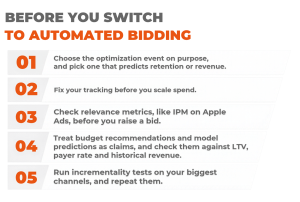
Automated bidding is usually the right call. These five checks, all drawn from 2026 sessions, help you hold on to the parts of control that still matter.
None of this asks you to fight the machine. The strongest teams trust automation with the work it does well, and they stay close to the decisions it can’t make for them.
They decide what to aim for, what counts as success and when a number doesn’t add up. For more on where that line sits, read Is Performance Marketing Becoming Too Automated?
Accountability is the one part that doesn’t move.
“Keep responsibility 100% human. AI can make mistakes. You should double check. You should be accountable for changes that you do at work.” (App Growth Summit Barcelona, 2026)
These are the conversations that fill an App Growth Summit room, practitioners comparing what their dashboards said with what really happened.
If automated bidding is on your team’s agenda for 2027, pull up a chair. Request your invite to an upcoming App Growth Summit event and bring your own story about the algorithm.