
AGS London 2026 – Inside a Sold-Out Day of App Growth
App Growth Summit London 2026 welcomed more than 300 app growth experts, as we filled the Tower Hotel throughout the day, and evening! AGS London featured 30+ speakers across 12+ sessions. The hand-picked, invite-only audience from all across the UK (and the world) got to hear insights from top brands leading the app growth space, so let’s dive into some of the key highlights from the event!
147 AI Experiments in Eleven Months
The day opened with an admission most AI talks skip. Colin Hodge, founder of the dating app DOWN, said he didn’t want to give one at all, then gave one anyway, built from 147 experiments his 27-person team ran over 11 months and sorted afterward into wins, failures, and everything in between.
The wins clustered around high-volume, low-judgment work. An internal tool that added captions to marketing videos cut that task by 90%, and an AI-run experiment pipeline let the product team launch two to three times more tests a quarter without adding headcount.
The failures were just as specific. An HR assistant that handled 5 recruiting emails flawlessly combusted at 80, mixing up subject lines and recipient fields until candidates got the wrong messages.
Hodge’s fix leaned on structure instead of tighter oversight. Chunk any task into pieces small enough for a human or an AI to hold, set a clear pass-or-fail goal instead of asking for an opinion, and build a file that captures every correction so the system stops repeating the same mistake. His closing line stuck with the room. Prompts decay, but loops compound.
Reaching Users Before They Start Searching
Reaching users earlier in the journey, before they’re fighting everyone else for the same high-intent crowd, was the next argument on stage.
Toni van Zütphen, Vertical Lead for Apps and Gaming at Snap, pointed to the platform’s scale to make her case, 956 million monthly users, more than half of them daily, and argued its real value sits in reaching people who barely touch other apps day to day.
Snap now counts 956 million monthly users, more than half of them daily, and van Zütphen argued the platform’s value sits in reaching people who barely touch other apps day to day.
Her creative rule was blunt. Judge every ad against a 3-second test that asks what this is, why the viewer should care, and what to do next, all inside the first few seconds, because attention rarely survives past that.
On measurement, she introduced Snap’s unified attribution product, built with MMP, which blends first-party Snap signals with MMP data in real time instead of waiting on delayed, siloed reporting.
One advertiser in real-money gaming saw a meaningful drop in acquisition cost after switching over.
Three Pillars Behind an Apple Ads Account That Scales
Viktor Orlov, CEO and co-founder of Asapty, made the case that Apple Ads rewards structure more than any other channel, since search intent stays stable and creative doesn’t burn out the way it does on social.
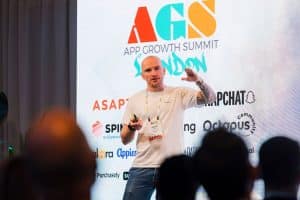
His framework rests on three pillars, single-keyword ad groups for full control over spend, custom product pages built to out-compete whichever app already ranks organically for that keyword rather than copying a rival’s page, and watching Impression Per Mille as the signal that tells you when something’s broken.
He also flagged a problem most marketers never think to check. Bot farms inflate impressions on unbranded utility keywords, which drags down IPM on the very terms worth the most.
Orlov’s case studies backed the framework up with concrete numbers, InDrive doubled installs at half the price with the same budget, and a gaming studio scaled installs roughly 13 times over after switching to keyword-matched custom product pages.
Food Delivery’s Shift From Installs to Lifetime Value
Food delivery has stopped treating the install as the finish line, and the fireside built around that shift paired Apurva Dubey, Senior Performance Display Specialist at Just Eat Takeaway, with Bidease’s Sema Toker.
Dubey described the UK as a hyperactive three-way fight between Just Eat, Uber Eats, and Deliveroo, where growth now comes from order frequency rather than new logos, while newer markets like Spain and Italy still need demand created from scratch.
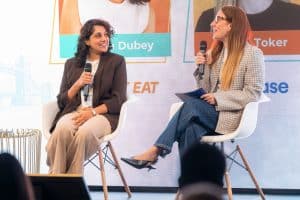
Post-pandemic, ordering shifted from weekend indulgence to a midweek utility, covering lunch, grocery top-ups, even breakfast, which changed both the media calendar and the budget split. Paid spend now goes almost entirely toward new and lapsed users, since loyal customers convert without a push.
Her team ran more than 200 incrementality tests with Google in a single four-month stretch in 2024, and the headline lesson was to stop chasing ROAS as the primary number. A hungry user was always going to order from somebody, so the question became which users were worth acquiring in the first place, judged by lifetime value rather than a channel’s own reported return.
A Panel on Where UA Budgets Are Shifting Next
A panel of Andy Park (Supercell), Anna-Maria Moira (Wolt), Jaimin Bhogaita (Muzz), and Lucrezia Leon (SpinX) dug into where growth teams are finding an edge once the obvious channels get expensive.
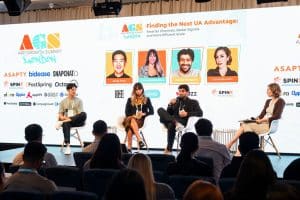
Bhogaita described Muzz’s approach to signal engineering, analyzing in-app behavior in the first six to twenty-four hours after install to isolate the actions tied to retention, then feeding those signals back to ad platforms.
A unified attribution test with Snapchat cut signup CAC by roughly 30%. Moira’s team at Wolt built an in-house AI tool that sets up and localizes campaigns across every platform in a handful of clicks, cutting campaign setup time in half. Park pointed to two channels most teams still underuse.
Email can reach millions of existing players without touching a paid budget, and a direct-to-consumer web store sidesteps the 30% platform fee entirely. Leon closed with a prediction that mini-series-style content, an app inside an app, is where advertising is headed next.
Two Organic Growth Teams Share What’s Working
One team hit a wall this year when its usual Instagram formats stopped performing, a moment they started calling cabbage internally.
Ayala Daly, senior creative strategist at mob, described hitting a wall this year when the brand’s usual Instagram formats stopped performing, a moment her team started calling cabbage.

Her fix was methodical. She tagged fifty of the highest-performing food videos across the industry by every variable she could think of, using a tool built on Claude to spot the patterns, and found that ASMR sound was non-negotiable at the highest view counts while voiceover only mattered at lower ones. The resulting series, built around a recipe called high protein smash, brought in roughly 800,000 followers on its own.
Peter Gillan, co-founder of the workout tracker Stronger, told a different version of the same lesson. His co-founder filmed their first viral TikTok on a whim in a garden center, and it pulled 800,000 views and 10,000 downloads before the team understood why it worked. From there, Stronger built its creative approach entirely around the app itself, setting up a joke and letting the product’s own interface deliver the punchline, without ever once saying download Stronger in the caption.
Across roughly two billion total views, Gillan estimated that 5% of Stronger’s posted videos carry 80 to 90% of the results, which is why his advice to the room was to build a system that keeps finding outliers instead of chasing any single winning format.
Moderator Hannah Parvaz, founder of Aperture, closed the session with the simplest advice of the day: Make your own content before you outsource it, because you can’t direct what you don’t understand.
What Moves Paywall Conversion Now
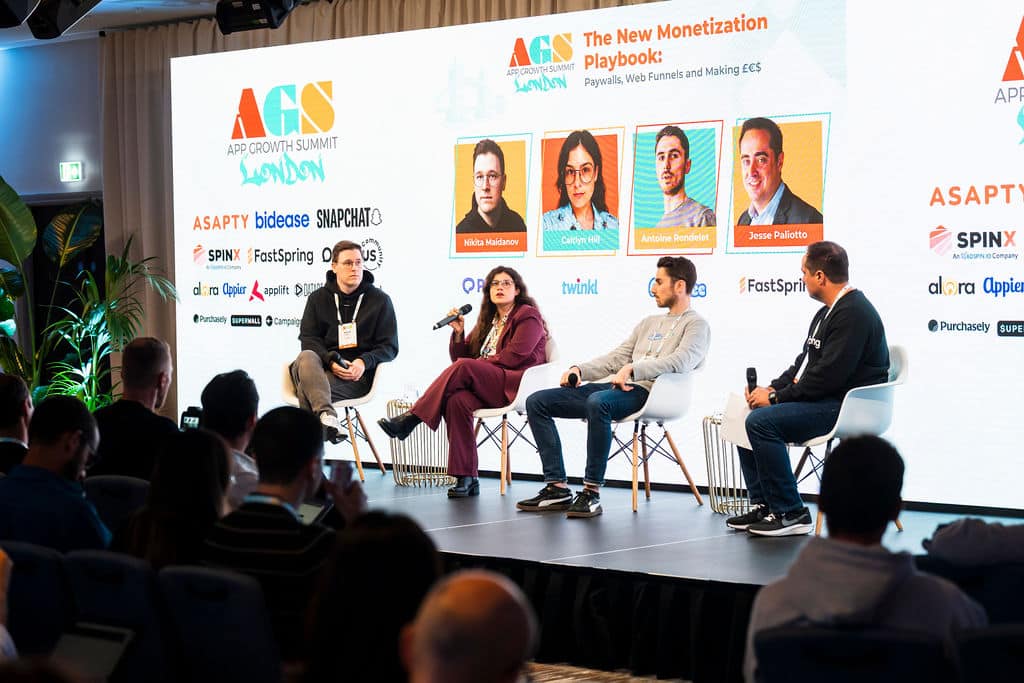
Jesse Paliotto of FastSpring moderated a monetization panel with Antoine Rondelet (Ganddee), Caitlyn Hill (Twinkl Parents), and Nikita Maidanov (Praktika), each bringing a different fix that had moved a real number.
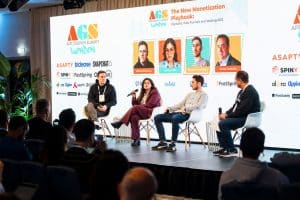
Rondelet’s small team at Ganddee strips paywalls down to the essential copy and reframes price per day rather than per year, a switch from £359 annually to 98p a day that consistently lowers friction for price-sensitive buyers. Hill pointed to a smaller but telling fix.
Switching a web-to-app funnel from text-to-download links to QR codes lifted conversion by 15%, simply because users no longer had to hand over a phone number. Maidanov’s team at Praktika saw a similar lift from a different lever, regional pricing raised average revenue per user by around 30% in some markets, and testing entirely different paywall structures moved the needle more than another round of button-color tweaks.
The audience Q&A added a useful benchmark for anyone building their own paywall. A healthy paywall-to-trial rate on iOS sits north of 20 to 30%, and trial-to-paid conversion above 35% is a reasonable target to aim for.
The Sweepstakes Program That Paid for Itself
Noa Gutterman, SVP Consumer Marketing at Mistplay, gave the day’s most unexpected talk. She started with a user complaint, “I love the games, I love the community, but it just isn’t hooking me,” and traced it back to a simple hypothesis. What if the reward itself needed to feel less certain and more extraordinary?
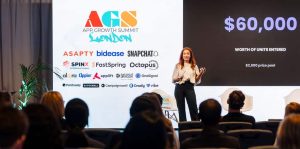
Her team tested that idea with a sweepstakes, launching with five $500 prizes that broke even in weeks, then scaling to a single $20,000 prize that quadrupled entries overnight.
To make the win feel real, Gutterman flew to Ohio to hand a winner a giant check on camera, and the resulting footage became Mistplay’s top-performing CTV ad for a full year afterward.
A second, Halloween-themed stunt, complete with a rented coffin and its owner’s day job as the town’s mayor, kept the format growing until the program expanded internationally under a dedicated Chief Sweepstakes Officer.
The results held up under scrutiny. Users who came in through sweepstakes creative were 41% more valuable by day 7, reached day-30 profitability 23% faster, and stayed 8 to 12% stickier than users acquired any other way. Mistplay spent roughly $250,000 on the program in 2025 and saved more than $1,000,000 in the process.
How Community Building Is Driving Retention
Only about 5% of users still have an app installed a month after downloading it, the blunt industry number this fireside opened with.
George Sullivan, founder of The Sole Supplier, and Gregoire Mercier, CEO of Octopus Community, opened with a blunt industry number. Only about 5% of users still have an app installed a month after downloading it.
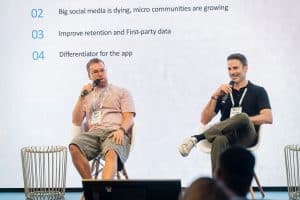
Sullivan’s team moved a 100,000-member Facebook group into their own app this year specifically to own that relationship instead of renting it from a platform, and solved the resulting cold-start problem by seeding the space with content from the team before opening it to members.
One early gamification test, a red notification badge pointing users toward the community, drove strong sign-ups, but the team pulled it once it started pulling attention away from the app’s main shopping feed, a reminder that a metric can improve while the business it’s meant to serve loses out anyway. The payoff for the users who stuck around was clear.
Community members generated close to three times more app sessions and set 60% more product alerts than everyone else. Sullivan closed with a wider read on why this matters now, engagement on the big social platforms has been sliding since 2022, and the smaller, safer spaces filling that gap are where brands need to show up next.
What Happens to Users After Onboarding Ends
Adrian Gray, Head of CRM at Sumup, moderated a panel with Jim McCarthy-Cheung (ManyPets), Timothy Lange (Vinted), and Sienna Pulati (Collctiv) on what happens after onboarding ends.
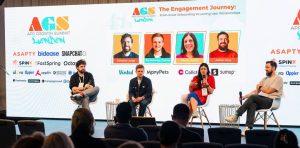
Lange described how Vinted models which product category a user is likely to try next, someone listing fashion items is a strong candidate for home goods or electronics, and how an in-house AI workflow cut campaign turnaround from three to 5 weeks down to 5 days without cutting the team’s headcount. He also flagged the flip side of that same personalization.
Search for something once, like a rare spare part, and the recommendation engine can spiral into showing nothing else for weeks, eroding trust rather than building it.
McCarthy-Cheung’s team at ManyPets found that addressing the pet by name in an email subject line outperformed addressing the owner. Pulati’s team at the fintech app Collctiv keeps AI out of customer support entirely, given how anxious people already feel about group payments, but leans on it heavily elsewhere, synthesizing a hundred user interview transcripts in minutes and building quick internal prototypes to test ideas before committing engineering time to them.
An AGS Exclusive From Soho House
Rajat Dhawan, Chief Digital & Technology Officer at Soho House, took the Main Stage for an App Growth Summit exclusive keynote built around two words he kept returning to, convenience and relevance.
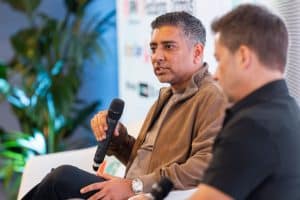
He walked through how Soho House turned its members’ app from something people occasionally opened into something they rely on, covering the rollout of House Pay, the shift toward AI-led personalization, and what it takes to make a membership feel personal at a company running hotels, restaurants, and clubs across 22 countries.
It’s the one session on the day’s agenda that isn’t appearing at any other conference this year, and there is more.

AI’s Growing Role in Creative Production
Elise Zareie, Head of Paid Social at Lingokids, closed out the day’s creative thread with Teddy Dassa (Bumpy), Annie Chen (DOWN), and Laura Baker (Bankin’).
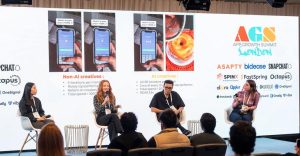
Baker’s team at the French fintech app Bankin’ keeps 60% of new creative as iterations on proven winners and uses AI-generated video to stretch a single concept from a handful of expensive shoots a month to 40 or 50 low-cost variations, three out of every ten of which become genuine top performers.
Chen’s team at DOWN ran a cleaner test of the same idea, swapping only the on-camera creator in an existing winning video and generating AI variants of the rest, and found that one AI-generated persona outperformed several of their real creators. Her summary of where the line sits was simple. Humans create, AI multiplies.
Dassa’s team at Bumpy runs the most demanding version of this, testing hundreds of creative combinations weekly across ten languages and twenty personas. Three internal teams split the work. One refreshes visuals on proven messages, one hunts for new personas entirely, and one cross-pollinates winning combinations across languages once it finds them.
Coffee, Lunch, and a Party by the Thames
Between sessions, Applift kept the coffee running all day, Dataseat covered the morning snack break, and Alora catered a full lunch at the halfway point and handled dietary requirements on request rather than as an afterthought.
Once the last session wrapped, the day moved outside for The Riverside Social, an open bar and live music by the water with Tower Bridge in view, the kind of close that turns a room full of speakers and strangers into a room full of people who’ll follow up with each other next week.

Request your invite to the next App Growth Summit and see which city on the 2026 calendar fills up next before the seats do!
For a preview of what the London recap deck will look like once it’s live, the AGS Berlin 2026 Insider Report is already out, covering that event session by session in the same format.