
What App Growth Leaders Are Actually Using AI For
App growth leaders aren’t debating whether to use AI anymore. They’re debating how to use it to become more efficient and effective. Whether it’s for content briefs, ad creative, pricing, customer support, or even deciding whether a new role needs to exist. What’s worth knowing is the pattern running underneath it all.
The leaders getting a real return are the ones who can tell you exactly where they stopped, not the ones who automated the most. One AI-forward marketplace keeps its customer support entirely human, on purpose. An equally AI-forward publisher runs 90% of its support through AI, on purpose too. Both leaders are right, because each asked a different question about what their own customers need before deciding.
Briefs Get Faster When AI Never Has to Re-Learn the Brand
Most of what slows a growth team’s AI use comes down to setup more than the AI itself. Every fresh chat starts from zero. The brand guide gets pasted in again, the audience redefined again, the tone restated again, and then everyone’s surprised the output shifts slightly every time.
The fix is simpler than most teams treat it. Load the context once, a brand voice guide (including the specific phrases the brand should never sound like), target keywords, audience personas, competitor gaps, and a file of what’s already worked, into a single persistent project, and every brief written after that inherits the full context automatically.
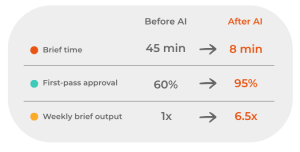
One two-person entertainment studio built exactly that setup. Content briefs that used to take 45 minutes now take 8. First-pass approval jumped from 60% to 95%. The same two-person team ships roughly 6.5x as many briefs a week without adding a single hire.
The same principle holds even for teams that never touch a chat window directly. Someone building tools for a subscription hobby-app studio put it more plainly on stage.
“Treat the command line the way you’d treat a spreadsheet. Nobody expects you to be a finance expert to use Excel well, and AI tools shouldn’t require an engineering degree either.” AGS Berlin 2026, Small Team. Big Output.
The AI itself hasn’t gotten meaningfully smarter in the past few months. What changed is that it stopped forgetting who a team actually is between conversations.
Workflows Now Take Minutes Instead of Weeks
That same shift, less time spent gathering and re-explaining, scales up to entire workflows too, not just single briefs. Testing a new batch of app ads used to mean a paid subscription, an agency retainer, and a 2-3 week wait for four or five variants.
One speaker rebuilt that whole cycle around a single AI workspace instead. Pull five to ten of a competitor’s longest-running ads first, since an ad still running is one that’s working, then let AI analyze the hooks, CTAs, and emotional triggers before generating anything new. The output was forty variants in under an hour instead of five in two weeks. After a 60-day test, cost per install fell 38%, QA time dropped 73%, and the agency retainer got canceled once the pattern repeated.
A vehicle-subscription marketplace applied the identical mechanism to pricing instead of creative. An agent scrapes every competing rental company daily and flags which cars are worth repricing, feeding straight into a CRM campaign. Days of scouting and analysis now take one person fifteen minutes a morning, managing pricing across tens of thousands of new users a month with no added headcount.
Every leader who shared one of these workflows named the same limit, unprompted. The compression only works because someone with judgment still checks the output before it ships. Ad creative generated this way gets you to roughly 60% of a finished concept, useful for testing a hook, not a finished video. Treating the output as a first draft rather than a final answer is what separates lasting value from just producing more content, faster.
Teams Are Drawing the Line on Where AI Falls Short
Not every part of the business leans on AI the same way, and the customer support split from the opening is a good example why. The marketplace keeping support human runs a peer-to-peer business where deliveries go wrong and packages go missing. The founder decided a customer with a real problem needs a person, not a phone tree with better manners.
The same choice looks different from the other side of it. The publisher running support at 90% AI is optimizing for something else entirely. Most of its tickets are simple subscription questions spread across dozens of titles, and speed matters more than a human voice when the question is that straightforward.
Neither company is being cautious about AI. They’re answering a different question about what their customers need.

The same instinct shows up on a smaller scale too. A meal-planning app tested AI-generated UGC, avatars included, and found click-through rate held up while conversion fell behind content made by someone with a following that already trusted them. After that, the team kept using both, AI for volume, people for anything that needs to close. A separate team built an agent to manage user acquisition across ten ad networks and fifty countries, one allowed to kill underperforming creative and adjust bids on its own but not to launch a new campaign or order new creative, a line the team drew on purpose.
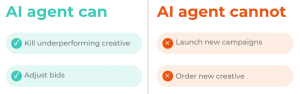
The most honest example of why that line matters came from the team running the pricing agent from the section above. Left alone, it defaults to raising prices, since higher prices look better on paper than the demand they might cost, and the tool speeds up the math without replacing the judgment call about what the market will bear. Two teams, working on unrelated problems, landed on the identical lesson. Let AI compress the research. Keep a person on the decision.
AI Recommendation Is Becoming Its Own Growth Channel
Everything above is a decision made inside a company. One founder made the case that a second, less obvious decision matters just as much, the one AI makes about a product without anyone asking it to.
Pick a persona, a user, an investor, a partner, and ask the question they’d search on their own, not a vanity check on the brand name. Read the answer diagnostically, not emotionally, for whether the product showed up, in the right category, described accurately, backed by evidence.
Then name the gap, whether that’s not appearing at all, filed under the wrong category, described badly, missing proof, aimed at the wrong use case, or the model surfacing something true and genuinely a problem.
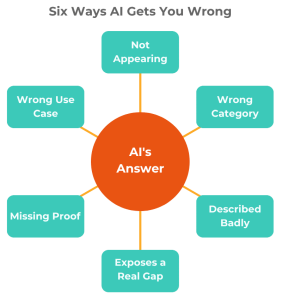
The fix depends on the gap. A visibility or narrative gap can be fixed with better copy. A proof gap needs evidence published somewhere AI can find it. But if the gap is the model exposing something the product hasn’t built yet, no homepage rewrite fixes that; it just teaches AI to describe the shortfall more precisely.
One founder saw the proof gap close firsthand. When Google featured her product in multiple developer showcases, the impact was dual: it sharpened the product narrative and planted verifiable evidence on pages AI models frequently crawl and digest. This wasn’t just a vanity win; it triggered unprompted interest from serious investors and potential acquirers. While she acknowledges these models remain black boxes, the correlation between visibility and high-value inbound interest was impossible to dismiss.
This shift in perception works both ways. A language-learning platform launched an accent-coaching tool and soon found AI recommending it for phonetic practice, a specific use case that bypassed its existing reputation for simple vocabulary practice. The team didn’t need to push for this positioning; they simply evolved the product, and the AI’s assessment of their core value evolved alongside it.
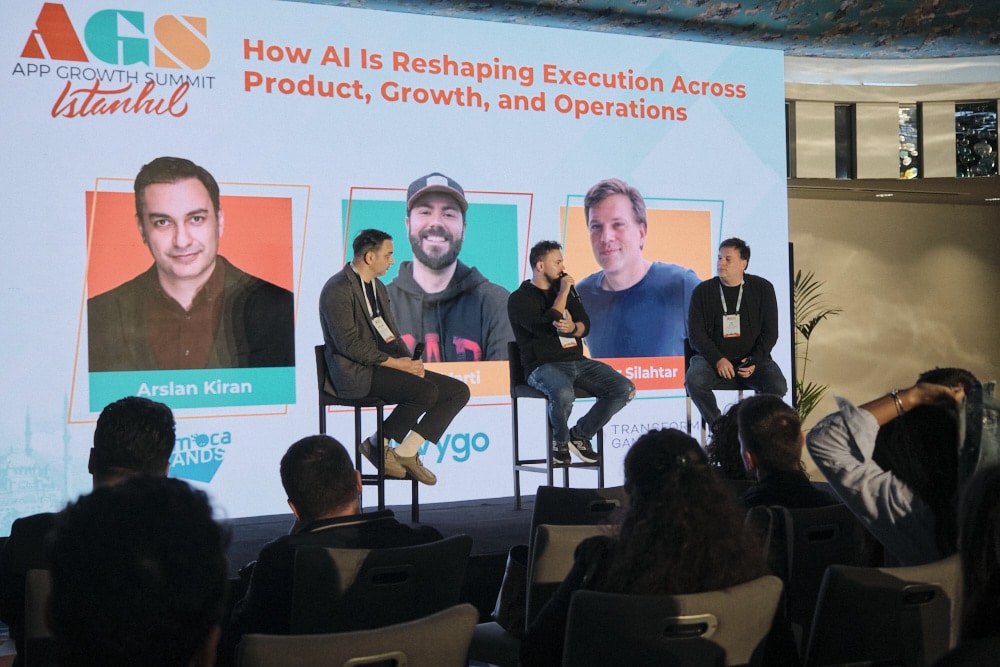
“You already spend energy on what your customers think of you. Start spending just as much on what AI thinks you are, since increasingly, that’s who makes the introduction.” AGS Istanbul 2026, Would AI Recommend Your Product?
Nobody’s Hiring One Person to “Own AI”
If deliberateness is the actual skill running through every example above, it’s worth asking who inside a company is supposed to have it.
When asked directly whether they’d hire a dedicated AI engineer or bring in an outside specialist to run AI strategy, three separate leaders gave the same answer without hesitating. No. The reasoning lined up too. Whoever needs the tool should decide how to use it, whether that’s someone on the UA team, someone in product, or someone in customer support. Hand the decision to an outsider, and the usual result is another dashboard nobody on the team opens.
What replaced the dedicated hire was something more distributed. One publisher let whoever on each team had taken to AI most naturally become that team’s go-to, then formalized it into its own internal division, sitting alongside growth, product, and data.
A 15-person studio took a more direct approach, one full day a week with zero daily-task pressure, just exploring and testing, nothing required to prove its worth yet. Two months in, that day stopped being exploratory and started producing shipped product features instead.
The teams pulling ahead right now can tell you exactly why they didn’t automate the rest, which turns out to matter more than how much they did automate.
Every workflow, every number, and every line of judgment in this piece came from a leader who said it out loud on an App Growth Summit stage this year, in a room full of people solving the exact same problem.
Check the App Growth Summit event calendar to see where the next one lands, and request your invite to sit in the room for the next round of these conversations yourself!